

2018 — Rationalist.org & Evrim Ağacı content
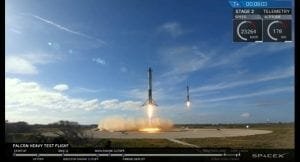
Falcon Heavy was successfully launched into space by SpaceX on February 6th. At 3:45 AM Eastern US Time, Falcon Heavy launched from Launch Complex 39A at the Kennedy Space Center in Florida. Stage separation and booster separation were successful, and both end cores made simultaneous and successful landings at SpaceX's 1 and 2 landing sites.
However, contrary to plans, the core failed to land on the company's remotely operated spacecraft, "Of Course I Still Love You," in the Atlantic Ocean. While SpaceX has not yet confirmed the core's loss, a voice in the rocket launch clip can be heard saying, " We've lost the core ."
The Falcon Heavy, currently the most powerful rocket in the world, was carrying a limited-edition Tesla Roadster as its payload, destined for Mars in an elliptical orbit around the Sun. Yes, really.
However impressive it may be, don't let the sports car playing David Bowie's " Space Oddity " and complete with a dummy in a spacesuit distract you from the main event.
In addition to contributing to the reduction of space debris in a unique way, this vehicle's journey to Mars proves that the Falcon Heavy can carry incredibly impressive payloads over very long distances from Earth.
Humanity's Next Stop
Although originally designed to carry humans, SpaceX CEO Elon Musk told reporters during a teleconference on February 5 that the Falcon Heavy would likely not be used for crewed missions. According to SpaceNews, Musk stated, “ The development of the BFR is progressing rapidly, and it appears there will be no need to use the Falcon Heavy for crewed space travel .” He added, “ We have opted to use Crew Dragon on the Falcon Heavy, in part to focus our energy on the BFR .”
However, Musk noted that unexpected delays in BFR development could change that. “ We’ll see how BFR development progresses ,” he said. “ If it takes longer than expected, we’ll go back to the idea of sending a Crew Dragon around the Moon on Falcon Heavy and doing different things with the crew on Falcon Heavy .”
With or without Falcon Heavy, one day one of us might go to Mars in a SpaceX ship. Sounds unbelievable? Thinking about it, the idea of a billionaire entrepreneur sending his personal car into space to test a massive rocket also sounds unbelievable.
Aside from SpaceX, humanity's capabilities for vehicles to travel to the Moon and Mars are quite limited. NASA is currently working on a Space Launch System (SLS) that is more powerful than the Falcon Heavy and capable of carrying passengers. It is projected to be ready in 2022, but delays are quite common when it comes to massive rockets.
It appears that Falcon Heavy will easily outperform other launch vehicles due to its lower cost. While other heavy launch vehicles cost between $500 million and $1 billion, Falcon Heavy will cost only $90 million. Given NASA's limited budget and the current administration's strong desire to return to the Moon, SpaceX's rocket seems like an attractive option for Mars.
This successful Falcon Heavy launch will help SpaceX generate interest in space exploration. This interest could lead to new partnerships and increased funding to support the ambitious work needed to get humanity to its next destination, Mars.
*BFR: Big Falcon Rocket *Space Launch System (SLS)
Translation: Ayşe Ege Palaz
• Futurism, "The Falcon Heavy Just Launched Successfully. Next Stop, Mars." < https://futurism.com/falcon-heavy-launched-next-stop-mars/ >
Originally published on Medium on April 24, 2023. English translation of “Falcon Heavy başarıyla fırlatıldı! Sıradaki Durak: Mars”.